

LISTEN: You intercept a transmission
I perform & record a monologue from a sci-fi play I'm working on

I’ve made a resolution: I’m going to have more fun. Otherwise, what’s the point of running your own platform? Here, all the creative liberties are up for the taking. Evolution is not only welcomed, but encouraged. Anyone who’s worked anywhere ever knows how hard it is to take risks where institutions and salaries are involved. Consequentially, it becomes hard to have fun.
But fun is a priority here at Free the Uglies. Fun isn’t just a novel experience, but an instinct and skill that one hones. A sense of fun and knowing how to have it is a muscle that one mindfully strengthens over time. When exercised regularly, the fun muscle often leads to innovation, invention, and A Silly Good Time.
I’ve been honing a clearer vision of where I want Free the Uglies to go as an interdisciplinary transmedia storytelling lab—and it’s all thanks to last week’s newsletter where I decided: it’s time to start having more fun.

ICYMI, I remixed the essay I wrote for SUNWW last year and recorded a reading of it.

Santiago and I had so much fun working on this recording together. So we wanted to do it again, but like, better.
Free the Uglies is a reader-supported publication that experiments in interdisciplinary transmedia storytelling. Your support means everything.

It’s the remix!
In its first few issues, Free the Uglies was preoccupied with investigations into creative life and culture. But from this point onwards—and up until FTU evolves once again—I’d like to focus on adapting, reimagining, and transmediating. This week and last, I remixed existing work of my own, but I’m also really excited to try my hand at playing around with other work.
What if this Mary Oliver poem were a dramatic scene? What if Disney’s The Little Mermaid were a YA dystopian novel? What if Baba Yaga were an internet-famous fanfic author?
This basic formula of what if x were y? could generate so much new and imaginative work. Any ideas? I really want to hear them.

Reimagining old work
I wrote Two-Way Telescope in the throes of the existential loneliness one cycles through in lockdown. It was an essay, but also something I imagined as an in-fiction radio transmission in this sci-fi play I was conceptualizing.
You can read the original piece here.
My sci-fi play has been on the drawing board for years, but it’s barely a crumb of a script. I realize what’s gotten in the way of my writing it—I’ve been pressuring myself to work in a particular order. To start at the beginning. To do it properly, whatever that meant.
But my brain doesn’t work that way. Everything is in medias res. Stories come to me in disparate fragments. Every time I resisted my natural creative sense, it always got in the way of the work.
I really enjoy writing dialogue—it might be my favorite part of writing drama—so it’d only be natural to start there.
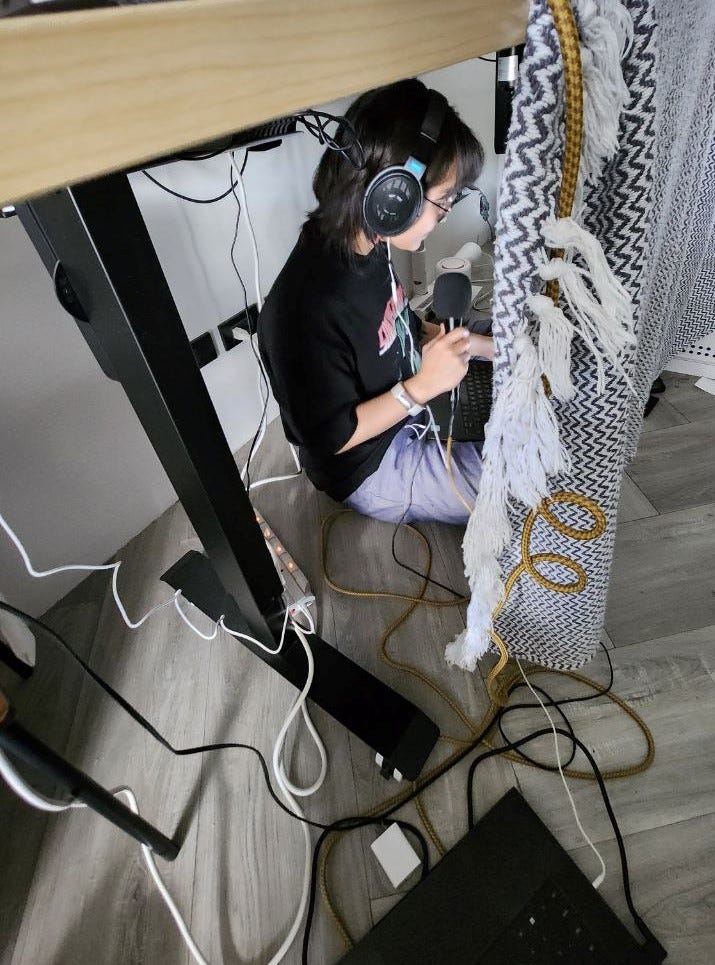
I took Two-Way Telescope and steeped it in the context of my play. To run through my process really quickly:
At first I rewrote TWT in more conversational language, because it was going to be spoken aloud this time around.
Then as I reread it multiple times, I allowed myself to discover the character’s motivations and what they’re situational circumstances might be.
Having a clearer knowing of the character’s motivations circumstances, I again rewrote the text.
Seeing what I’d come up with so far, I decided on a specific time and place in which the monologue takes place. I also decided on the challenges the character would encounter during the monologue (for example: a risk of getting caught). I rewrote accordingly.
Having a clearer sense of time and place, I reread the text in order to immerse myself in the character’s emotional state, and what they feel towards who they’re speaking to. Again, a rewrite.
Then general finetuning. I reread and turned the text over in my mouth multiple times, feeling where it naturally flowed and where it staggered and stuttered. I actually do this during every step, but more so at the end, right before recording.
As I described the atmosphere of the monologue, where it takes place and when, Santiago began designing a soundscape for it. While recording the monologue, I listened to the soundscape in order to further immerse myself in the character’s situation.

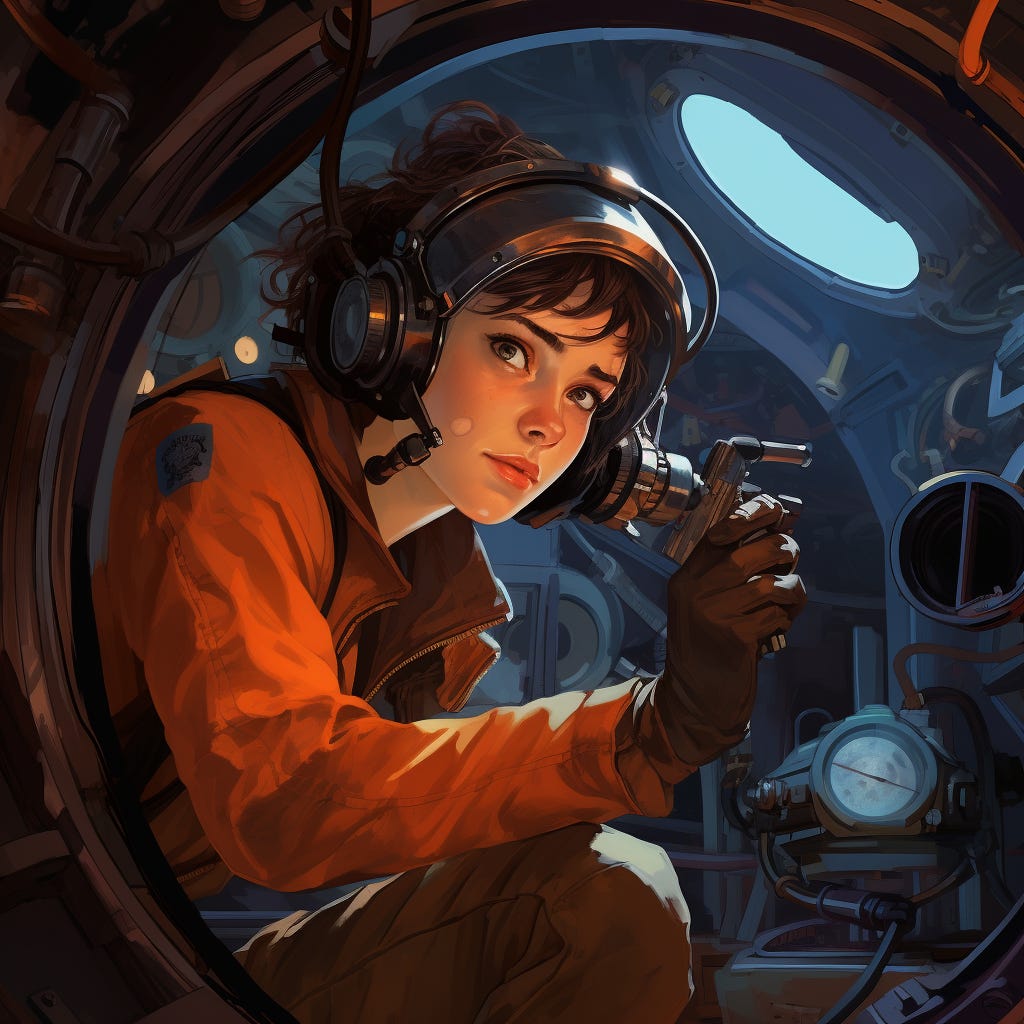
You intercept a transmission.
It's me again. I know, it's silly. You might not even be receiving any of these, but I—
I never told you—and I don't think I ever— I don't think I ever told you how much it means to me that— I know you know that I'm—
I wanted to tell you I'm happy you left.
You were always so much bigger than this place. So much braver than me. I hope you're seeing everything you wanted to see. I hope you saw those lights you talked about so much. I hope… you're happy. Just keep going! I— This can wait.
You know, sometimes, I close my eyes, and I see your life play like a movie. The screen is so far away, but I feel... happy. I'm so happy I get to see any of it at all. But god, I miss— I wish—
[Beeping] Shit.
Think of me? No matter where we end up, or who we become?
I promise. I'm never too far away.

I need your help!
What kind of person do you imagine this character to be? What situation are they in? What’s their relationship with who they’re talking to?
What kind of story do you envision this becoming? Or rather, what kind of story would you like it to be?
Would you like to experience this story as a play, a podcast, or something else?
Also, would you be interested in performing some of my text?
Your thoughts are invaluable.
And you are the best!
Stay Free,

And yes I’d love to perform some of your writings.
This is so lovely and real, especially with the sound design. I love it.
I imagine this character to be talking to a close friend or brother-like character who has left for an adventure or to pursue some dream, maybe battle. This character believes her life to be relegated to the mundane, not knowing that this message she is recording is one of the last before her life changes forever in some way and becomes incredibly colorful, weird, and challenging in its own rite.